

Introduction
Artificial intelligence has made remarkable advances in recent years. From creating realistic portraits to generating convincing videos and human-like conversations, AI tools have transformed how people interact online. Unfortunately, these same technologies are increasingly being exploited by scammers.
According to cybersecurity experts and consumer protection agencies, AI-generated identities are becoming one of the fastest-growing threats across dating platforms, social media, freelance marketplaces, and messaging apps. Criminals now use AI-generated profile photos, deepfake videos, cloned voices, and automated chatbots to build trust with potential victims before attempting financial fraud or identity theft.
Whether you’re connecting with someone through a dating app, professional networking platform, social media, or an online community, learning to recognize fake identities is an essential digital safety skill in 2026.
This guide explains the most common AI profile scams, warning signs to watch for, and practical ways to verify that you’re interacting with a genuine person.
Why AI Profile Scams Are Increasing
Generative AI tools can now create:
- Hyper-realistic human portraits
- Professional headshots
- Entire social media personas
- Fake resumes
- Synthetic voices
- Deepfake video calls
- Automated conversations
Unlike older scams that relied on stolen celebrity photos, modern AI-generated profiles often use completely fictional faces that have never existed.
This makes traditional reverse image searches less effective because the image isn’t copied from another website.
Scammers typically use these fake identities to:
- Build emotional relationships
- Request money
- Promote cryptocurrency scams
- Conduct investment fraud
- Steal personal information
- Spread phishing links
- Recruit money mules
- Commit identity theft
Common Types of AI-Generated Profile Scams
1. Romance Scams
One of the most common forms of AI identity fraud involves fake romantic relationships.
The scammer spends days or weeks gaining trust before introducing an emergency or investment opportunity.
Common stories include:
- Medical emergencies
- Overseas travel issues
- Military deployment
- Business investment opportunities
- Cryptocurrency trading
- Family emergencies
Never send money to someone you have only met online.
2. Fake Professional Profiles
LinkedIn and freelance platforms increasingly encounter fake professionals created using AI-generated headshots.
Warning signs include:
- Recently created accounts
- Limited work history
- Generic recommendations
- No mutual connections
- Poorly written experience descriptions
Always verify credentials independently.
3. Investment Communities
Fraudsters often create AI personas claiming to be successful investors.
These accounts may:
- Display luxury lifestyles
- Share fake trading screenshots
- Promise guaranteed profits
- Invite users into private messaging groups
Remember:
If someone promises guaranteed investment returns, treat it as a major warning sign.
4. Customer Support Impersonation
Scammers also create fake customer support accounts that imitate:
- Banks
- Cryptocurrency exchanges
- Technology companies
- Online retailers
These profiles often respond quickly to public complaints before directing users to fake login pages.
Always verify support accounts through the company’s official website.
How to Spot AI-Generated Profile Photos
AI-generated portraits often contain subtle imperfections.
Look for:
Unnatural Eyes
The eyes may:
- Look slightly uneven
- Have inconsistent reflections
- Appear unusually glossy
Strange Backgrounds
Many AI images contain:
- Blurred architecture
- Random objects
- Distorted furniture
- Impossible room layouts
Inconsistent Hair
Hair is one of AI’s biggest weaknesses.
Watch for:
- Hair blending into clothing
- Missing strands
- Irregular edges
- Floating hair sections
Asymmetrical Accessories
Common clues include:
- Different earrings
- Distorted eyeglasses
- Uneven jewelry
- Warped headphones
Blurry Hands
Although improving, AI still struggles with:
- Fingers
- Hand positions
- Fingernails
- Watches
- Rings
Red Flags Beyond the Profile Picture
A fake profile is rarely identified by the photo alone.
Pay attention to behavioral clues.
They Avoid Video Calls
Scammers often make excuses such as:
- Broken camera
- Poor internet
- Privacy concerns
- Constant travel
While privacy is understandable, repeated avoidance of any live verification can be a warning sign.
Their Story Changes
Notice inconsistencies involving:
- Age
- Occupation
- Location
- Family
- Education
- Travel history
Genuine people generally remain consistent.
Fast Emotional Attachment
Many romance scams involve:
- Excessive compliments
- Love bombing
- Talking about the future immediately
- Emotional dependence
Healthy relationships develop gradually.
Immediate Move to Private Apps
Scammers frequently encourage moving from legitimate platforms to:
- Telegram
- Signal
This reduces platform moderation and reporting.
Requests for Money
The biggest warning sign is any request involving:
- Gift cards
- Cryptocurrency
- Bank transfers
- Emergency loans
- Investment opportunities
Legitimate relationships should never begin with financial requests.
How to Verify Someone Safely
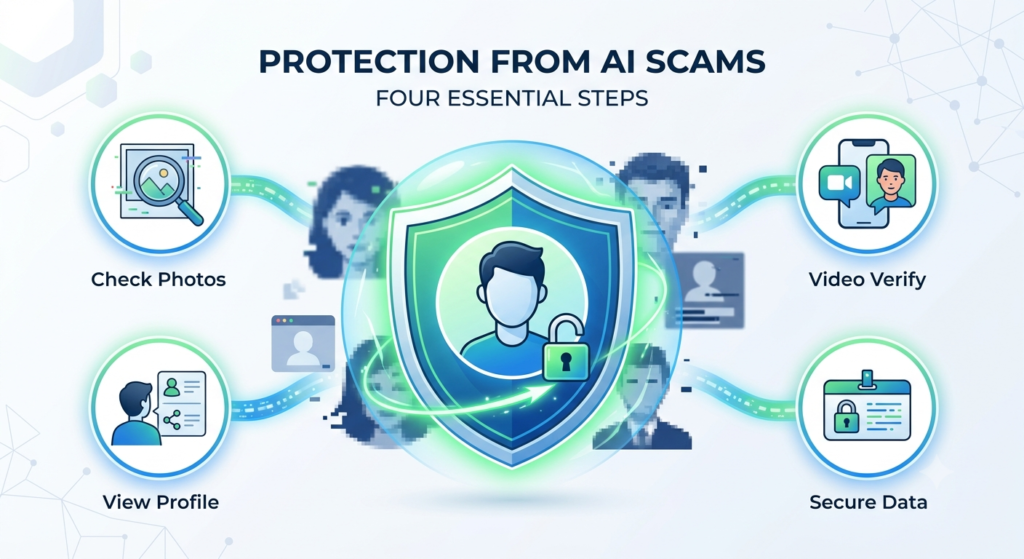
1. Reverse Image Search
Use:
- Google Images
- Bing Visual Search
- Yandex Image Search
Although AI-generated faces may not appear elsewhere, stolen images often will.
2. Request a Live Video Call
A short live conversation helps verify that the person matches their profile and can reduce the risk of interacting with a fake account.
3. Check Their Digital Footprint
Look for consistency across:
- Professional profiles
- Social media
- Public posts
- Tagged photos
- Long-term activity
Authentic users usually have a history rather than an account created just weeks ago.
4. Verify Shared Information
If someone claims to work for a company:
- Check the company website
- Look for employee directories
- Confirm publicly available information
Never rely solely on screenshots.
5. Trust Independent Sources
If someone recommends an investment platform or service, research it independently before signing up or sending money.
Protecting Your Privacy
Avoid sharing:
- Government ID
- Passport
- Driver’s license
- Banking information
- Home address
- Workplace details
- Verification codes
Use strong, unique passwords and enable multi-factor authentication on important accounts.
What to Do If You Suspect a Scam
If something feels wrong:
- Stop communicating.
- Do not send money.
- Save screenshots of conversations.
- Report the account to the platform.
- Block the profile.
- Change passwords if you’ve shared sensitive information.
- Monitor your financial accounts for suspicious activity.
If you’ve lost money or shared financial information, contact your bank immediately and report the incident to the appropriate consumer protection or cybercrime authorities in your country.
Best Practices for Staying Safe Online
- Verify identities before building trust.
- Be skeptical of profiles that seem too perfect.
- Never rush financial decisions.
- Keep conversations on moderated platforms until trust is established.
- Regularly update your privacy settings.
- Learn about new AI scam techniques as they evolve.
Digital literacy is one of the strongest defenses against modern online fraud.
Conclusion
AI has made online interactions more realistic than ever, but it has also lowered the barrier for scammers to create convincing fake identities. By paying attention to inconsistencies, verifying information independently, and taking your time before sharing personal details or money, you can significantly reduce your risk of becoming a victim.
Remember that genuine relationships—whether personal or professional—are built on transparency, consistency, and mutual trust. If a profile seems too perfect, moves too quickly, or pressures you into financial decisions, it’s worth pausing and verifying before proceeding.
Staying informed about emerging AI-enabled scams is one of the best ways to protect your identity, your finances, and your peace of mind in 2026.
Frequently Asked Questions
Can AI-generated profile photos fool reverse image searches?
Yes. Since many AI-generated faces are entirely synthetic, they may not appear anywhere else online. Combine reverse image searches with other verification methods.
Are video calls enough to verify someone?
Not always. While a live video call can help confirm that you’re interacting with a real person, advanced deepfake technology exists. Consider multiple verification methods, especially for high-stakes situations.
What is the biggest warning sign of an online scam?
Any request for money, investments, gift cards, cryptocurrency, or sensitive personal information from someone you’ve only met online should be treated as a serious red flag.
How can I report an AI-generated scam profile?
Use the reporting tools on the platform where you encountered the profile. If financial fraud or identity theft is involved, report it to your local cybercrime or consumer protection authorities.
References
- U.S. Federal Trade Commission (FTC). Romance Scams (updated 2025): https://consumer.ftc.gov
- FBI Internet Crime Complaint Center (IC3). Annual Internet Crime Report (latest available): https://www.ic3.gov
- National Institute of Standards and Technology (NIST). Digital Identity Guidelines: https://pages.nist.gov/800-63-3/
- Europol. Threat Assessments on AI-Enabled Crime: https://www.europol.europa.eu
- Cybersecurity and Infrastructure Security Agency (CISA). Phishing and Online Fraud Guidance: https://www.cisa.gov